If you run a small business, do you really need a small business website of your own? It’s one of the questions I hear most often from owners of smaller companies – local service providers, brick-and-mortar shops and people who work entirely offline. Usually it isn’t a lack of interest behind it, but doubt: “Will it pay off?”, “Do I even need it?”, “Is my business big enough to invest in a website?”
If you have similar doubts, this article is for you. It won’t be a technical lecture, just practical answers: why a small business needs a website, how to make it visible in Google, what it costs and where to start.
Your customers look for you on Google
Imagine you need an electrician, a hairdresser or a good caterer. What do you do first? You search on Google. Your potential customers do exactly the same – whether you run a beauty salon, a workshop, a local shop, a law office or a service company. If you’re not there, they keep looking. Without a website, you’re standing right next to the place where all the traffic is.
It’s not only about new customers. Even people who already know you want to check you online: see your offer, photos and reviews, confirm your opening hours or send a quick message through a form. Customers rarely ask “Do you have a website?” anymore – they simply look for it, and if they can’t find it, they choose a competitor.
A good website:
- builds trust and a professional image,
- lets people learn about your offer without calling or visiting,
- shows reviews from other customers and examples of your work,
- works around the clock, even when you’re asleep or taking time off,
- makes it easier to run ads and promotions with full analytics.
Why a Facebook or Instagram profile isn’t enough
I often hear: “I have a Facebook page, people can see me!” Great – social media is a real asset. The problem is that, first, you don’t have full control there: one day the algorithm promotes your posts, the next it hides them from most of your followers. Second, customers expect more than photos and short service descriptions.
Business websites let you organize information, present your offer the way you want, show your work and – most importantly – make sure customers find answers to their questions without having to message you. That saves time on both sides.
Your own website is also your own space. You don’t depend on the moods of platforms, changes to their terms, paid reach or sudden account bans. You have full control – visual, functional and marketing.

Visibility in Google – how to get your business found
The truth is simple: if your business isn’t on Google, for many people it doesn’t exist. People trust what they see high in the search results and usually choose businesses they find nearby or on the first page. A website is only the beginning – it also has to be visible.
Website traffic – what does it actually mean?
Website traffic is the number of people who visit your site. The more visits, the bigger the chance that someone will call, ask about your offer or place an order. But that traffic doesn’t come out of nowhere. Your site has to be visible in search, and its content has to answer your customers’ questions and needs.
Technical basics and SEO
Professional web development means preparing a site so that Google can read and index it properly. The foundations are fast loading, working well on every device, a well-planned structure and the right keywords.
SEO – search engine optimization – is more than technical fixes. It also means working on content, structure, internal links and links from other sites. Every website I build for clients is a foundation for further marketing: SEO, ads, articles and expansion.

Content that answers customers’ questions
The second pillar of visibility is content. An example? Someone types “how much does a website cost” plus the name of their city into Google. If you have a good article on that topic, there’s a fair chance they’ll end up on your site.
Good content takes time, though: analyzing your offer, choosing the services you most want to sell, keyword research and placing the texts properly within your site structure. I often see business owners watch a few TikTok videos and then try to optimize their site on their own – and instead of improving results, they make them worse, sometimes for a long time. If you want to do it yourself, book a consultation first. I’m happy to help you avoid the most common mistakes.
How much does a small business website cost?
What if you’re just starting out and your budget is limited? It’s a very common question, and I understand it well. A small business website doesn’t have to be a large portal. Often a simple, clear and attractive site with the basic sections is enough – one that shows who you are, what you offer and why people should trust you.
With me, a website costs from €600 / $650 (net), and a larger site with many subpages from €1,000 / $1,200 (net). You’ll find the details in my pricing, and I explain what the final price depends on in the article how much does a website cost. I match the project to your company’s stage of growth – no artificially inflated costs, no unnecessary features. If you’re just entering the market, I’ll build a version you can easily expand later. If you need something more advanced right away, that’s fine too.
Treat it as an investment, not an expense. Your own website makes your business more credible, helps you reach new customers and gives you full control over how you present yourself. In practice that means more inquiries and a stronger position for your brand in your local market.
What do you need to get started?
To launch a website you need three things: a domain, hosting and a well-designed site.
A domain is your website’s address, for example yourcompany.com – what customers type into their browser.
Hosting is where all your website’s files are stored. It’s what keeps your site available online around the clock. When choosing a provider, don’t just go for the cheapest plan. Look for automatic daily backups, a free SSL certificate, fast SSD/NVMe storage, servers located close to your customers (for EU businesses, ideally in the EU for GDPR reasons) and support that actually answers. And always register the domain in your own name, not your web developer’s.
Want to dig deeper? On the blog you’ll find the articles “How web hosting works and why it matters” and “Where to buy a domain”.
Website examples – how could your business be presented?
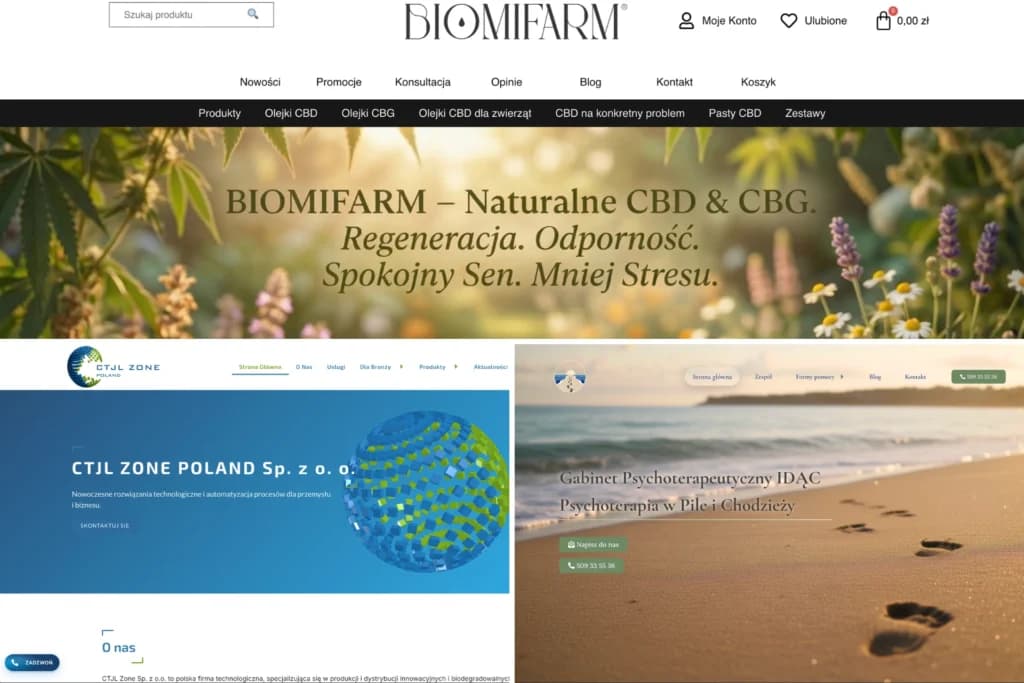
Every business is different. A beauty salon presents itself differently from a local repair service, and a service brand differently again. That’s why example websites are often a big relief for clients – they show which direction we can take visually, functionally and conceptually. When you see real solutions, it’s easier to decide. Take a look at my portfolio.

No time or know-how? I’ll take care of it
That’s completely normal – you run a business, not a web agency. That’s why I guide you through the whole process: I talk with you, advise you and build the website from scratch, step by step, so you always know what’s happening. I also take care of SEO, content and setting up analytics tools – and I explain everything in plain language.
You don’t need to understand the technical side. Just tell me about your business, your customers and your goals. I work remotely with businesses across Europe, the US and Canada – we can talk things through calmly on a video call, at a time that suits your time zone.
Does a small business need a website?
If you care about a professional image and new customers – yes, definitely. Your website is your command center, your business card and the foundation of your online presence. You don’t have to be a large corporation to look professional. All you need is a well-planned, solidly built website.
I offer a free, no-obligation consultation. Write or call me – we’ll work out what you need and plan a website that genuinely supports your business.