
If you are thinking about getting a website built, you probably already know that running a business without one is hard today. Your own site is a business card, a source of leads and a sales tool all in one. So you start browsing offers and quickly notice a huge price gap. On one side, quotes from independent specialists. On the other, slogans like “website for under $100”, “ready-made site in one day” or “cheap website for small businesses”. The temptation to save money at the start is understandable – every euro and dollar counts in a small company, and the starting budget is rarely big.
But do you really want the first impression your business makes online to look “cheap”? In this article I explain why a cheap website is usually not a good investment, and what to look at before you choose who builds it.
What is a cheap website, really?
Imagine buying a car for half the price. At first glance everything checks out – four wheels, a steering wheel and an engine. But when you try to drive off, the brakes work “sort of” and the radio only turns on during a full moon. A cheap website is very similar.
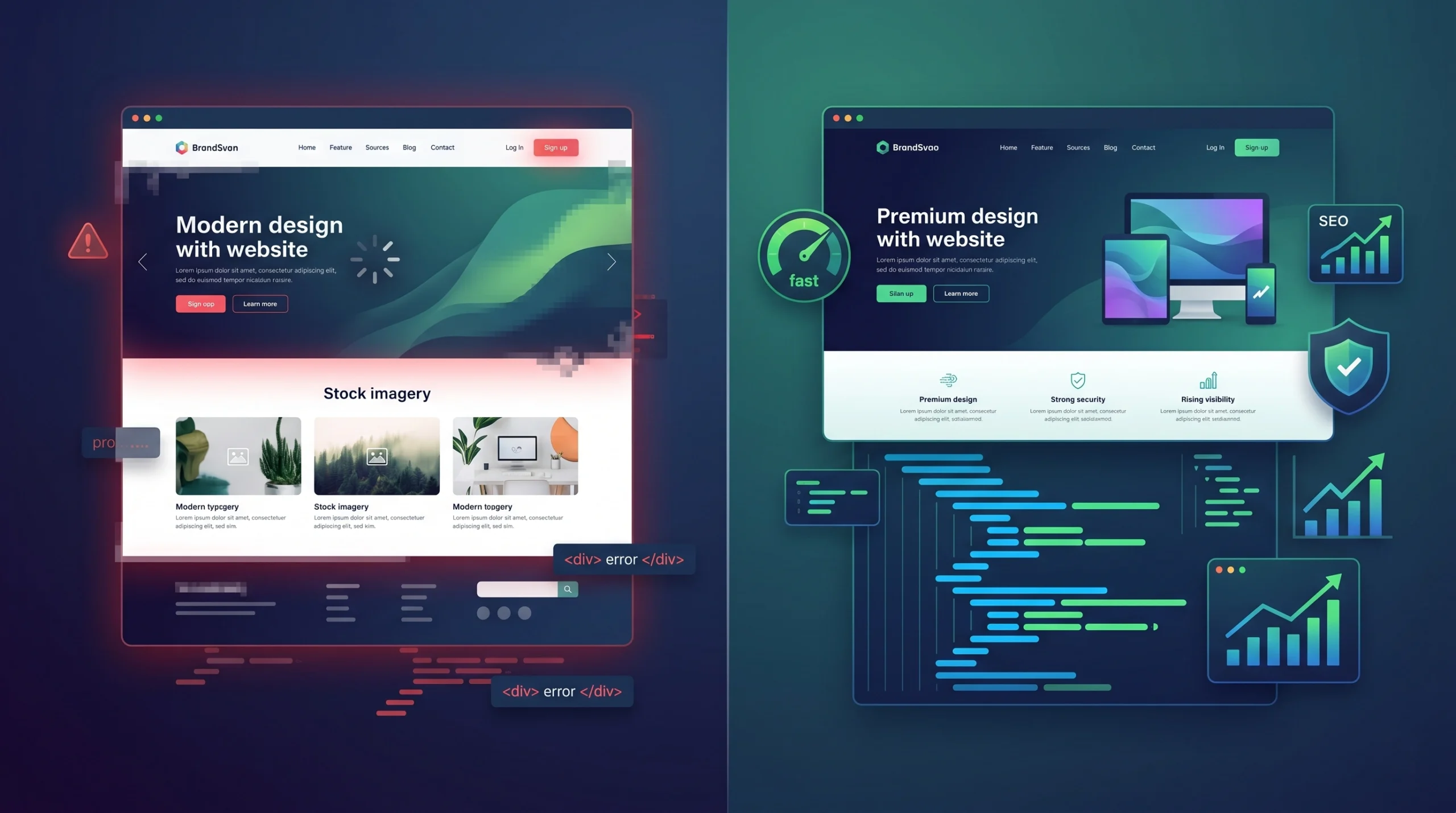
Most often it is a heavy, mass-produced template that someone has hastily repainted in your brand colors. It is built quickly, with no look at your industry, no SEO strategy and no usability testing. The result? The site looks like hundreds of others, works poorly on phones, and Google barely notices it exists.
On top of that, cheap builds rarely come with any technical backing. They are not properly secured, there are no backups, and the first system or plugin update can break the whole site. At that point the “saving” ends with a call to a specialist who has to rescue the situation – and a bill that often exceeds the price difference you saved.
What your customer sees – trust is built in seconds
Look at the site through a visitor’s eyes. They land on it and immediately notice that everything loads slowly, elements fall apart on mobile, the text is hard to read and some links lead nowhere. On top of that, the browser warns that the site may not be secure because it has no SSL certificate.
Your customers use apps from the biggest tech companies on their smartphones every day, and that is the standard they are used to. If your site takes too long to load or looks broken on a small screen, many of them will close it after a few seconds and go to a competitor.
A website is your virtual office, open 24/7. A stranger who lands on it for the first time judges your credibility in a split second, based on what they see. A messy layout, random photos and missing contact details set off alarm bells. If the site looks rushed, that is exactly the picture the customer will form of your business.
A well-planned custom website works the other way round: it builds trust from the first click. It shows that you take your business seriously – and that tells the customer you will treat them with the same care during the sale and after it.
Cheap websites and SEO – why Google doesn’t see them
Looks are just the tip of the iceberg. A cheap website usually has poor-quality source code, overloaded with unnecessary scripts that clash with each other. That almost always means slow loading, and Google does not reward slow, badly optimized sites.
The second typical problem is no SEO at all. Without properly set titles and descriptions, fast loading and a sensible link structure, the site simply does not exist in search. You can have the best product in your industry or deliver outstanding service, but if nobody finds you on Google, nobody will ever know.
A properly built website is designed with search visibility in mind from day one. Headings, compressed images and content are prepared so that search engines can read them well. When you invest in a project like that, you get more than a nice look – above all, you get traffic, which means real customers.
Cheap solutions and data security
Another trap people often overlook is security. In cheap builds, this is usually where things fall short. Many of these sites run on free themes or abandoned plugins that their developers no longer update. For an attacker, that is an open door – one hole in the code is enough to get access to the site, customer data and sometimes even the whole server.
Business owners sometimes only find out about the problem when the site suddenly disappears, starts redirecting to strange pages, or Google flags it as dangerous. You lose not only your customers’ trust but also your search visibility, and rebuilding your reputation can take weeks, sometimes months.
Security is not only about protection from attacks, either. It also means storing personal data properly, complying with GDPR and having a valid SSL certificate that encrypts the connection between the user and the server. On a site without SSL, the browser shows a “Not secure” warning – and many potential customers simply leave.
I write more about protecting user data and why technical security affects your brand in “Website data protection: the basics every business needs”. You usually can’t see this foundation, but it decides whether your business is truly credible online. Unfortunately, many people only appreciate it once something goes wrong.
How much does a good website cost, and what drives the price?
The question most business owners ask is: “How much does a good website cost?” A quote is more than a fee for graphics and a WordPress install. It covers:
- research into your industry and competitors,
- a site structure that matches your business goals,
- SEO optimization so you are visible on Google,
- content that actually sells,
- setting up forms and connecting maps, social media or a booking system,
- security and responsiveness testing.
How I work – no middlemen, from research to launch
I work alone, with no salespeople, subcontractors or interns. From the first call to launch, you deal directly with me – the person who actually builds your website. Clients from abroad work with me remotely, which in practice means video calls, email and a shared preview of the site as it grows.
Every quote is individual. First I get to know your business, your industry and your customers. Then I plan a structure that makes sense both for users and for Google. Only then do I move on to the design and build. I rely on proven WordPress, which gives you stability, security and room to add more features later.
You don’t have to take my word for it. I have built websites for very different industries: from modern 3D tools and an importer of foreign sweets, through beauty and medical businesses, to industrial chemicals. Take a look at my portfolio and see what we could build for your brand.
Cheap website or investment – summary
A cheap website may look like a bargain, but in practice it brings more problems than benefits. Weak security, low quality, no SEO and a damaged brand image are costs you don’t see straight away. When choosing who builds your site, look beyond the price – focus on experience and the result you want to achieve.
Want to know what your website should cost? You don’t have to compare offers in the dark. Book a free consultation – I will explain what drives the price in your case, which mistakes to avoid and how to plan a website that brings real results.